Lishui Guyan Huaxiang
丽水古堰画乡
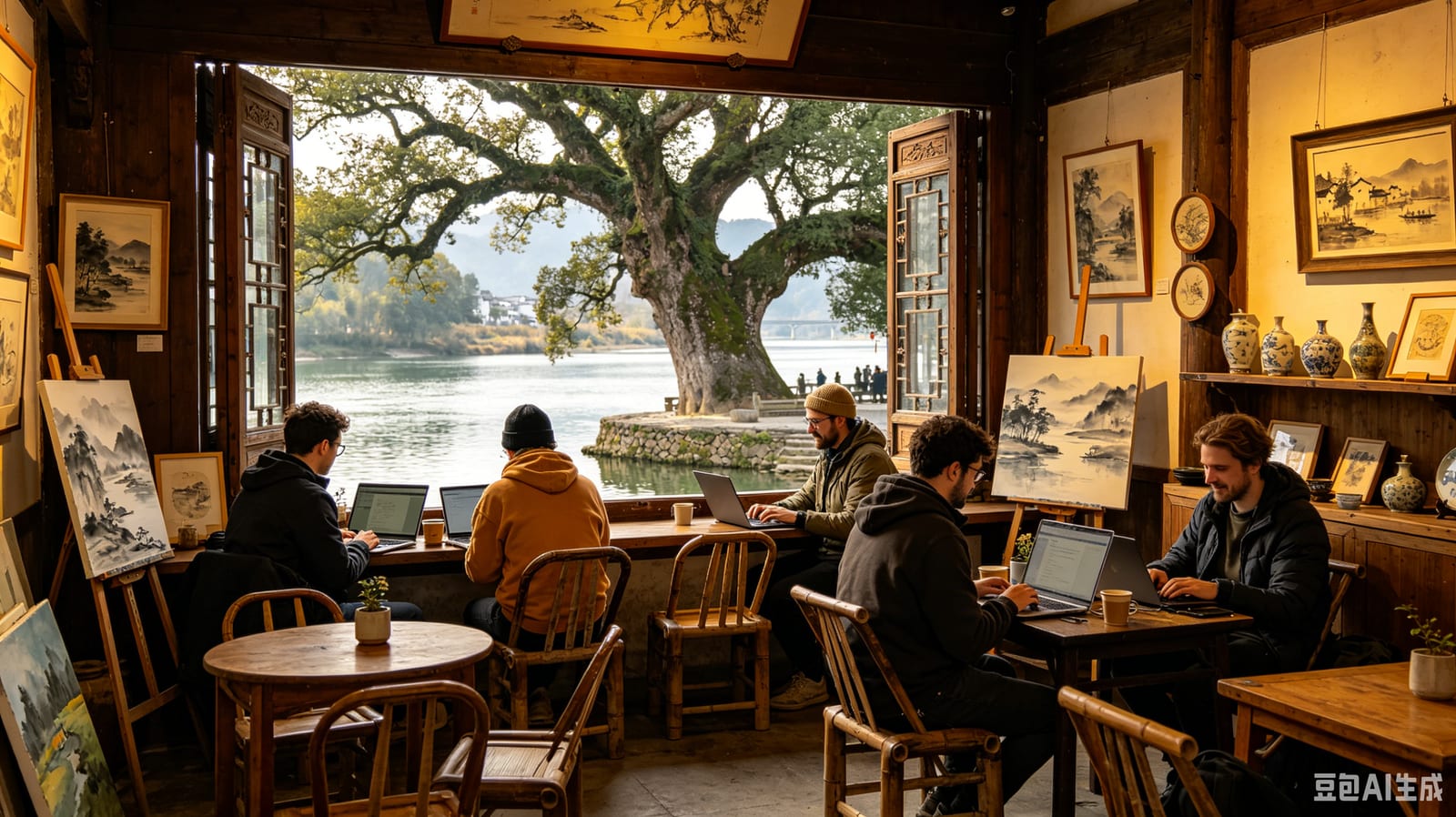
Guyan Huaxiang is one of China’s original rural creative residences — a model that has since been replicated across the country but rarely matched for authenticity. Located in Liandu District, Lishui, the community spans both sides of the Ou River: the Huaxiang (Painting Village) zone in Dagantou Township and the Guyan (Ancient Weir) zone in Yantou Village, Bihu Township. The village was a working river port in the Song dynasty; the warehouses and courtyards have been carefully adapted rather than demolished and replaced.
The core operating venue is the 52Hz Digital Nomad Community, covering more than 3,000 square meters of converted historic architecture. The base is also the flagship location for China’s first prefecture-level government policy framework dedicated entirely to digital nomads — a designation that comes with a meaningful suite of practical benefits.
The appeal of historical texture
Most co-living spaces give you white walls and standing desks. Guyan gives you a stone floor that was laid 400 years ago, timber rafters that creak in the wind, and a view of the Ou River where wooden boats still pass. The area is the birthplace of the Chinese Barbizon School of oil painting — galleries, artist studios, and craft markets are embedded in the historic streetscape rather than bolted on as amenities.
For creative workers — photographers, writers, architects, illustrators — the environment is productive in ways that manufactured modern spaces simply aren’t. The surrounding prefecture has forest coverage exceeding 80%, with the Ou River running through the center, ancient camphor groves, whitewashed Jiangnan vernacular buildings, and the Tongji Weir irrigation system, a UNESCO World Irrigation Heritage site.
Who comes here
The resident mix skews creative: graphic designers, documentary filmmakers, independent architects, illustrators, writers, cross-border content creators, and English education professionals. Academic researchers on China projects also come for extended stays. The vibe is less startup and more residency-program. Since opening, the community has hosted more than 3,000 nomad stays, including residents from Hong Kong, Macau, Taiwan, and multiple countries across Europe and the Americas. The average resident age is 28, and the proportion of postgraduate-educated creative workers is notably high.
Community and programming
Weekly events include plein-air oil painting sessions, skill-swap markets, English-language salons, book clubs, tea-picking hikes, and group dinners. The base regularly partners with local artists and intangible cultural heritage practitioners for collaborative projects — content creation, brand design, and digital storytelling opportunities that connect residents to the regional creative economy. Many long-term residents arrive for a month and leave with creative partnerships they didn’t expect.
The atmosphere is deliberately unhurried. The social culture rewards depth over breadth: people know each other’s projects, and genuine collaboration — on content, on creative work, on joint applications for local grants — is common.
Internet reality
Fiber broadband runs at 200–500 Mbps down and 40–80 Mbps up across the core community, with 5G coverage throughout. This is considerably faster than a standard rural Jiangnan town, and reliable enough for international video calls, content production, light coding, and day-to-day remote work. Performance is more consistent than most rural co-living options in Southeast Asia.
That said: if your work involves uploading large video files daily at high volume, verify current speeds with the base before committing. If your work involves thinking and writing — or creative work that benefits from intermittent rather than constant connectivity — this is an excellent environment for it.
Getting there
Take the high-speed train from Hangzhou South to Lishui (approximately 1.5 hours; Shanghai is about 2.5 hours). The base’s staff will arrange transport from Lishui station. Direct services also run from Wenzhou, Fuzhou, and other cities along the Zhejiang–Fujian corridor. Once in Lishui, the community is about 20 kilometers from the city center — 30 minutes by bus or taxi.
Pricing
Overall costs run 40% or more below comparable options in Hangzhou or Shanghai. 2026 reference pricing:
- Standard single room (converted historic building): ¥1,500–2,500/month
- River-view or courtyard room: ¥2,500–3,800/month
- Room + shared coworking bundle: ¥2,800–4,000/month (includes coworking access and community programming)
- Daily food: ¥20–50/day via the community canteen, local restaurants, or delivery
Total monthly cost for accommodation, coworking, and basic living typically falls between ¥4,000–6,000 — roughly on par with mid-range Southeast Asian nomad destinations, with considerably more stable infrastructure and logistics.
The local support package
Lishui is the first prefecture-level city in China to launch a comprehensive citywide digital nomad policy framework. Guyan Huaxiang, as the flagship community, provides access to both municipal and district-level benefits:
Municipal “Ten Measures for Co-Living and Co-Creation”:
- Cultural access: Digital nomads receive free entry to Lishui’s major scenic areas, including Guyan Huaxiang, Jinyun Xiandu, and other A-rated sites
- Startup grants: Qualifying projects can apply for up to ¥20,000 in cash awards and up to ¥800,000 in guaranteed loan financing; incubator placements come with up to 300 square meters of free workspace for three years
- Community insurance: All nomad communities citywide are covered by a ¥2,000,000 liability policy; discounted youth apartment rentals at 50% of market rate are available
- Growth pathway: Access to a startup mentor network, skills training, and the “Green Valley Elite” talent program — which offers up to ¥10,000,000 in entrepreneurship funding and loan subsidies for qualifying applicants
Liandu District “Six Measures” support package:
- Historic buildings and cultural tourism spaces opened as incubation venues for nomad-led projects
- Introductions to local artists and intangible cultural heritage practitioners for creative collaboration
- Regular digital nomad innovation and startup competitions with cash prizes and resource matching for finalists
The countryside advantage
Lishui prefecture is one of Zhejiang’s most pristine natural areas — 80% forest coverage, dozens of waterfalls within an hour’s drive, and the Zhejiang section of the ancient Jinwen Road. The Ou River walking path, ancient weir scenic area, plein-air painting grounds, and outdoor hiking routes are all accessible from the community on foot or by bicycle. Living here for a month reshapes your sense of what China is.
For international residents
English service is available through the operations team. Core areas carry bilingual signage. The community has established international residents, and the social environment supports cross-language exchange naturally. Lishui has extended foreign payment convenience across key merchants, scenic areas, and supermarkets — foreign bank cards are accepted at most locations, and Alipay and WeChat Pay can be linked for mobile payments. Cash is rarely needed.
Short stays under 30 days work on a standard tourist visa. The base provides residency documentation and consultation for longer-term residents pursuing company registration or the relevant residence permits. Applications can be submitted through the “DN Lishui” mini-program with no formal eligibility threshold; a 7-night trial stay is available. Creative and light-remote-work projects are prioritized in the review process.
Who it’s for
Painters, designers, photographers, architects, and writers who need an environment that actively feeds their work rather than simply tolerating it. Cross-border content creators and English educators who want a low-cost base with stable connectivity and cultural depth. Digital nomads interested in extended immersion in Chinese rural and historical culture. Remote workers on a mid-range budget who want long-term accommodation with a genuine sense of place.
Compared to Dali, Guyan Huaxiang offers a stronger Jiangnan cultural identity, more vertically focused artistic atmosphere, and better infrastructure — with closer proximity to the Yangtze River Delta cities. Dali has more expansive natural scenery and a livelier nightlife scene.
Compared to the Shanghai bases (Xinfeng or Caojing OPC), Guyan Huaxiang is lower cost, richer in cultural and natural experience, and better suited to creative and lifestyle-oriented nomads. The Shanghai properties offer stronger tech resources, denser startup policy support, and better international logistics for founders who need those things.
Compared to Anji DNA, Guyan Huaxiang has a 5A scenic area designation and a depth of art and cultural programming that Anji doesn’t match. Anji skews more toward industrial-chic rural living and outdoor physical activities.
Amenities
- ·Historic Jiangnan courtyard and riverside architecture (converted Song-dynasty buildings)
- ·Shared coworking hall, private meeting rooms, soundproofed focus pods, reading and consultation room
- ·Riverside outdoor workstations and ancient camphor-tree shade desks
- ·35 guest rooms accommodating up to 45 residents; standard singles, river-view rooms, and courtyard rooms
- ·Room + coworking bundles available; move-in ready
- ·200–500 Mbps fiber + 5G full-property coverage including outdoor areas
- ·Community canteen, shared kitchen, and café social zone
- ·Self-service laundry, 24-hour hot water, 24-hour security
- ·Ou River walking path, ancient weir scenic area, plein-air painting grounds
- ·Weekly oil painting sessions, skill-swap markets, English salons, book clubs
- ·Local artist collaboration and cultural heritage programming
- ·One-stop company registration, grant application, and policy filing support
- ·Free entry to Lishui's A-rated scenic sites (policy benefit)
- ·Apply via "DN Lishui" mini-program; 7-night trial stays available
Plan Around This Base